hoBIT: A Profile-Aware Retrieval-Augmented Chatbot for University Academic Advising

Identical advising questions can require different answers depending on department, admission cohort, and degree program.

Yoonseo Kim, Seongmin Lee, Joongheon Kim, SeongKu Kang*
Korea University, Seoul, Republic of Korea
*Corresponding author.
EMNLP 2026 Demo Submission
Profile-dependent advising questions require different evidence for different students.

proFILL extends hoBIT with profile-aware indexing and on-demand adaptive profiling for university academic advising.

Same Question, Different Correct Answer

Semantically similar curriculum documents can apply to different students. proFILL makes evidence validity profile-aware.

Profile-Blind Retriever

"Can you tell me my graduation requirements?"

Semantically similar document

Plausible but inapplicable evidence can lead to the wrong answer.

proFILL in hoBIT

Dept: CS, Cohort: 2020; graduation requirements?

Profile-matched source evidence

Applicable evidence is retrieved from a profile-indexed corpus and reused through the session profile.

Why - hoBIT?

Academic advising is profile-dependent: semantic similarity alone can surface plausible but inapplicable evidence.

Profile-blind RAG misses context

Graduation, course, and major rules vary by department, admission cohort, and major type, so the same query can require different documents.

Profile-aware indexing structures evidence

Each chunk is annotated with applicable profile values and the fields required to interpret it reliably.

Adaptive profiling keeps interaction light

proFILL acquires only the attributes needed for the current query, then updates the session profile on demand.

Project Overview

Explore the paper through five views: methodology, chatbot capabilities, dataset construction, LLM prompts and judges, and evaluation results.

hoBIT Overview

Two complementary components: offline profile-based indexing + online adaptive profiling.

proFILL overview: offline profile-based indexing (left) and online on-demand profiling (right).
Offline profile-based indexing pipeline

① Offline Profile-based Indexing

  • Corpus: 5 institutional sources — regulation & orientation PDFs, department webpages, board notices, admin FAQs
  • Chunking: 800-char semantic chunks (paragraph → sentence splitting)
  • LLM annotation: each chunk tagged over 5 profile attributes
    • department · major type · grade · admission year · student status
    • Non-applicable attributes → null (chunk applies to all)
  • Two collections:
    • Static — stable materials (regulations, curricula, FAQ)
    • Dynamic — frequently updated (notices, jobs, events)
  • Hybrid retrieval: BM25 + text-embedding-3-small

② Online Adaptive Profiling

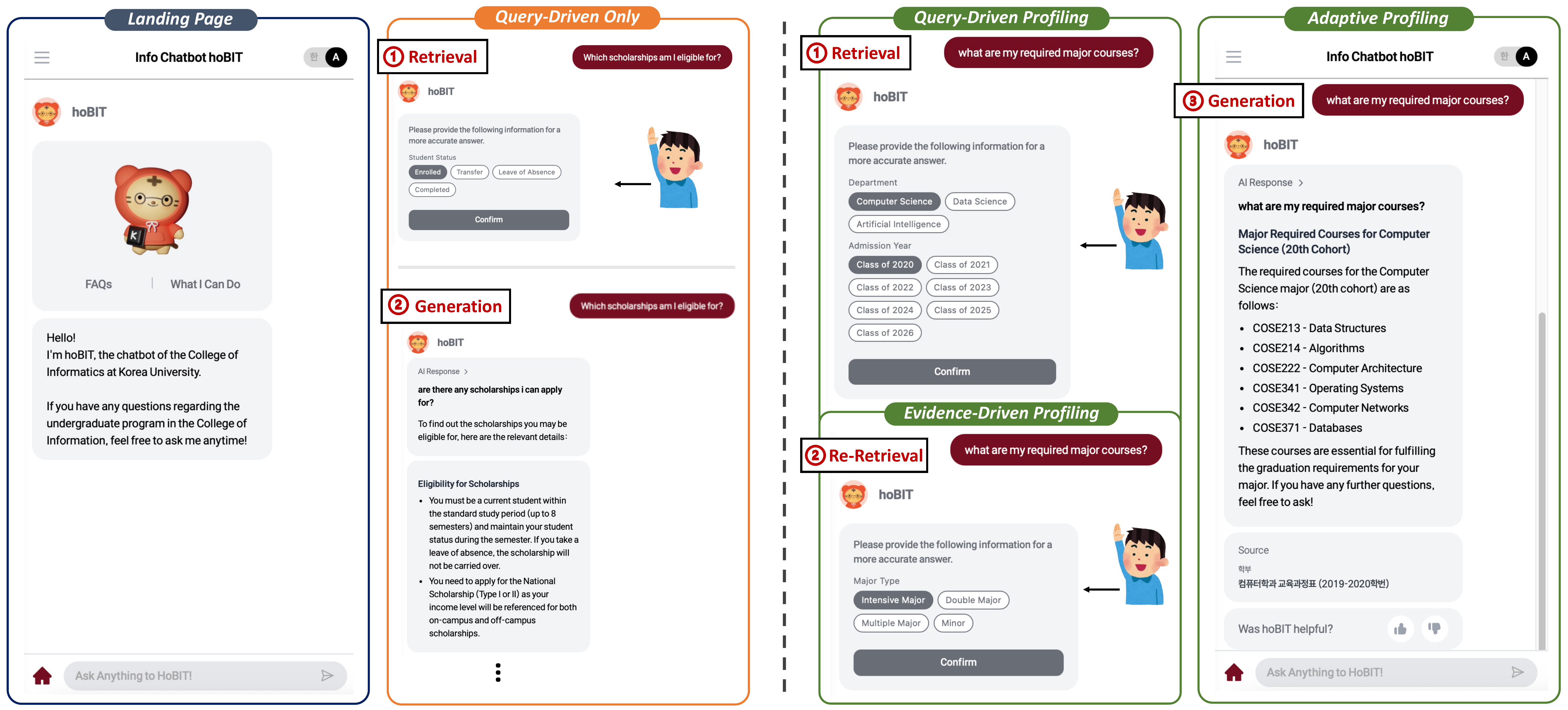
On-demand profile acquisition in two stages — no upfront login or full profile form.

  • ① Query-driven profiling — before retrieval
    • Infer required attributes from query intent
    • Ask user only for missing ones
  • ② Evidence-driven profiling — after retrieval
    • Inspect top-k evidence
    • Ask follow-up if applicability still unresolved
    • Re-retrieve with updated profile
    • Triggers for 24.3% of queries on average
  • Profile injection:
    • Soft query augmentation (profile serialized as prefix)
    • Hard filtering (over profile annotations)
Online adaptive profiling: query-driven and evidence-driven stages

hoBIT System

End-to-end runtime pipeline — intent routing, profile-aware retrieval, time-aware aggregation, grounded answer generation.

hoBIT full system diagram

Intent Routing

  • LLM classifier → 5 intents
  • Only retrieval queries → RAG pipeline
  • Others (greeting, ability, faq, smalltalk) → template / FAQ / lightweight reply
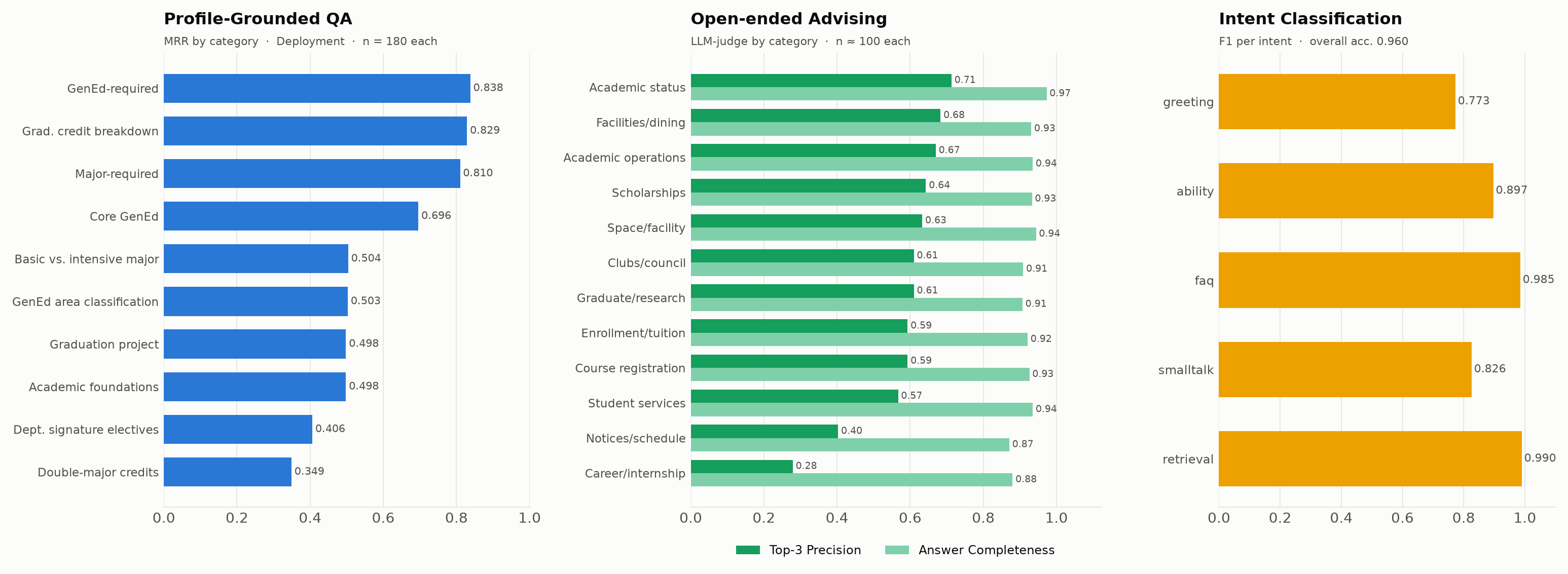
  • 96.0% accuracy on 1,600 evaluation queries (retrieval F1 = 0.99)
Intent routing 1 — direct-response intents
Direct-response intents — no retrieval invoked
Intent routing 2 — retrieval path
Retrieval intent enters proFILL's RAG pipeline

Time-aware Retrieval

  • Hybrid retrieval per collection (dense + BM25, RRF k=60)
  • Top-10 chunks selected under the ratio below
  • Dynamic collection: 90-day half-life recency score

Rule & Regulation Queries

Time-insensitive — curricula, policies, FAQ

7 Static
:
3 Dynamic

Weight the static collection — stable answers dominate.

Notice & Event Queries

Time-sensitive — notices, jobs, school events

3 Static
:
7 Dynamic

Weight the dynamic collection — recent notices surface first.